Two Dollars (Deux Dollars)
“I wish projects would come to you. In fiction, you are always responsible for your projects. I suppose that once you’re famous, people approach you with scripts and all, but even then, those are not stories that come from within yourself.”
“We originally made ‘Two Dollars’ during an event in Quebec called Kinomada, where filmmakers write, produce, and direct a short film in 10 days. It’s an explosion of creativity, but there’s almost no time for production. Two days prior to our shoot, we still had no location and no actors! So we were calling actors we had never met and who had never heard of us and asked: “do you want to be in a film the day after tomorrow?” Most of them said yes, but I was terrified as I didn’t know how capable they were… but when they showed up to rehearsal, I was relieved to see they were very good!”
“The shoot itself was fun, but the conditions were very dire: we only had a couple of lights, and both the cinematographer and sound engineer were running on no sleep as they had shot two other shorts the night before! We did our best during the shoot, but once finished we had another challenge: there was only 48h to edit a 10 minutes film, if we wanted to be part of the final Kinomada screening. I edited for literally 36 hours in a row, I would only occasionally stand to eat and go to the bathroom. The scriptwriter and the 1st AD were doing all they could to keep me awake, sometimes even telling me where to click, it was quite funny. We finished 1 minute before the final deadline.”
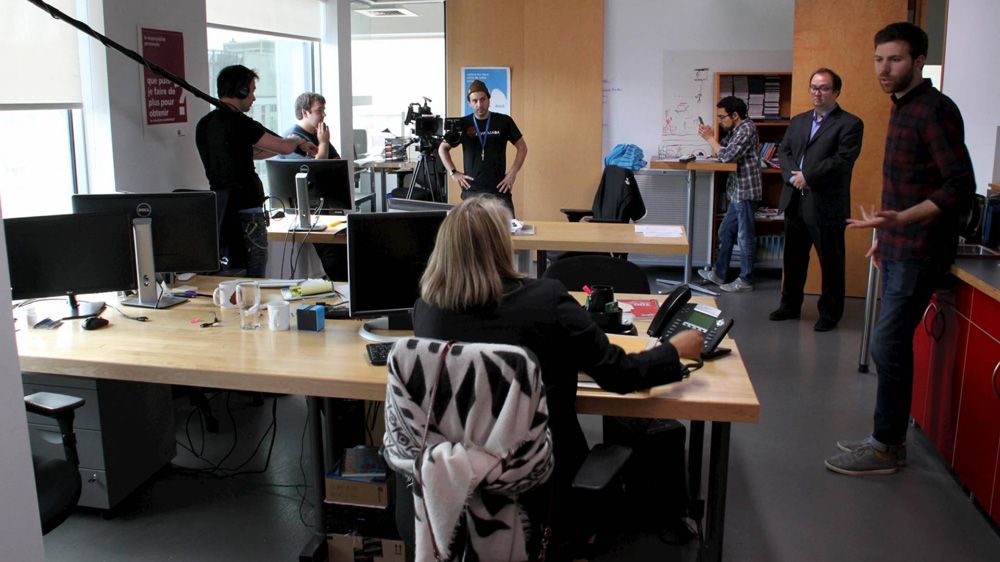
“The good thing with shooting in an office is that you are in a regulated, quiet, location. A company from Quebec city was kind enough to let us us their office during the weekend, and things went really smoothly on that regard!”
“The screening went super well and we had a decent film to show, but with some flaws, so we even considering dropping the film forever. That’s when Zangro, a French producer (considered by Variety as one of the 10 emerging producers to watch) came to the rescue: he invested in a real post-production, and we distributed the film, and it was very successful.”
“I think there is a film that we admire so much that we watch it regularly, it’s the Damián Szifron film, Wild Tales, with those 5 short films around human rage. Other references include most of the films from the Coen brothers.”
“In our previous project, Sans Plomb, we did a 7 minutes (fake) single-take, but in this one, everything is done in a rather classic way as you can probably tell. That’s mostly due to the lack of time, there was no time for complicated shots. The setup was was extremely minimal: a Red Scarlet, two Kino Flos, and some microphones. That’s it. The post production was done in two parts: we already had a first film at the end of the Kinomada event, where I had done the edit with the help of the writer and the 1st AD.”
“When the producer got in and things got more serious, we did a second round of editing using FCPX at Les Pirates in Bordeaux, and the sound by PuteauxLand in Paris with Pro Tools. Yann Tribolle, a great colorist and cinematographer did the color grading with DaVinci Resolve. Personally I enjoy the post-production a lot more than the shoot, because there’s no stress, you have time to try everything and to take your decisions.”
“Making a film is always a little bit difficult, especially in the days leading up to the shoot, there’s so much stress. But I never regretted a single day, and we have been blessed with a really strong reception of the film, so there is definitely no regret.”