Over the Moon

Zander:
“This short film, ‘Over the Moon’ is set soon after the events of our feature film ‘Cosmos’, which audiences continue to really enjoy and message us asking for a sequel. So we thought it’d be a really cool idea to jump back into that world and tell a bit of a sequel story in short form. And having also just got our hands on Blackmagic’s new Pocket Cinema Camera 6K Pro , and needing to familiarize ourselves with its advanced technology ahead of a scheduled production, we thought there was no better opportunity to directly compare this camera’s new capability with that of the original 2013 Pocket camera we shot our feature on.”
“On this short, I did a bit of visual effects work but nowhere near as much as on ‘Cosmos’ thanks to the low-light capability of the 6K Pro. On ‘Cosmos’, we really wanted our night exteriors to have a big-budget, high production value look. But since it was a no-budget movie, we had very limited resources (3 LED panel lights to be precise) and could only just light the area where we were filming. And when we started editing the footage together, it just looked as if the actors were walking around in a very dark space – like being inside a black box with no depth.”
“So to address this issue, I utilized my experience in visual effects to add skylines, tree lines, and some stars to the backgrounds, giving us a sense of depth. Initially, we had around 8 sky replacement shots planned, but seeing how effective the results were, this escalated to over 70 sky replacement shots in the finished feature. Obviously, this was a very time-consuming process for a 128 minute movie, but it worked really well, and I was genuinely happy with the results.”
“But naturally, I wanted to avoid that same issue on this short film, and when we decided we’d be shooting on Blackmagic’s Pocket 6k Pro, which is much more sensitive than the original Blackmagic Pocket Camera, we considered shooting across dusk for real, with the aim of capturing the British summer late-evening sky glow directly in-camera. It was a challenge we willingly set for ourselves.”
“In preparation, we went into our garden, set up some lights, and began conducting tests during sunset. Our goal was to determine the realistic duration of a workable filming window and figure out how much time we had to actually get the short in the can. During these tests, we carefully balanced the relationship between key light, backlight, and the background sky.”
“Elliot had his light meter and took readings to ensure the ratio between the filming lights and the other elements remained consistent, regardless of how dark the sky became. The key light always had to match a desired ratio, maintaining visual continuity throughout the filming process.”
Elliot:
“Since we were filming during a very brief 50 minute period in the evening, we needed to understand how quickly the light was diminishing. This knowledge allowed us to make timely adjustments to the ISO and camera settings, ensuring light levels remained consistent. Through our tests, we discovered the sky’s exposure value was dropping approximately one stop every five minutes, which was quite rapid.”
“At the beginning of the night, we utilized one of the 6K Pro’s inbuilt ND filters and set the ISO to a low value. This approach required us to use lots of light to illuminate the actress and match the brightness of the lighter background. However, as the night progressed and darkness set in, we removed the ND filters, increased the ISO, and lowered the intensity of the lights. This adjustment during filming completely removed the need for the type of sky-replacement we’d had to create for ‘Cosmos’.”
“In post-production on ‘Over the Moon’, we only had to make minor tweaks, such as adding a few twinkling stars, to achieve the desired final look. The whole process worked wonderfully and resulted in a stunning dusk effect, captured for real in camera.”
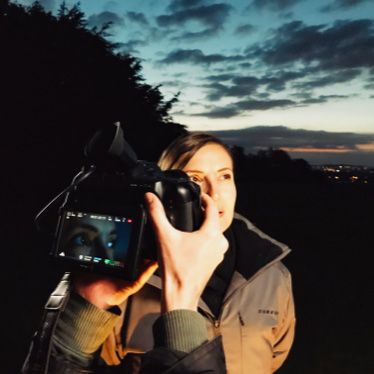
“Another interesting challenge we faced was creating the eye light effect when the character looks through the telescope. When you gaze at the Moon through a lens, you realize how remarkably bright it truly is, and we wanted to replicate that feeling authentically on screen. To achieve this, we came up with a creative solution.”
“We used our phone’s torch feature and securely positioned the phone with a magic arm in front of the telescope’s lens. By shining the light down the lens, it projected out of the eye piece, bouncing off and illuminated the talent’s eye, simulating the natural pinpoint of light one experiences when observing the Moon.”
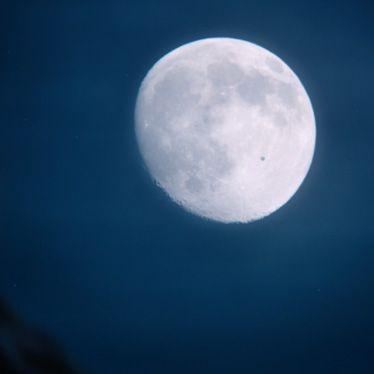
“Along with getting the eye light right, we had to obviously capture the Moon in all its glory. When we received our Pocket 6K Pro camera, the first thing we wanted to do was attach it to the backend of our Celestron telescope and see what the Moon looked like in 6K.”
“We patiently waited for a beautiful, clear night with a waxing gibbous Moon. Our goal was to capture the terminator line, the boundary between the shadow and lit halves of the Moon, which really accentuates the scarred cratering on the lunar surface.”
“The 1325mm length of the telescope lens was so long that it was impossible to capture the entire Moon in a single frame. To address this, we decided to lock the camera in place and let the Moon move through the frame. We first focused on capturing the bottom half of the Moon and then repeated the process for the top half. In post-production, Zander composited these two shots together, creating a glorious full Moon image with a resolution greater than 6K. This high resolution provided us with ample flexibility for further creative vfx work.”
“The end result was stunning to look at. We affectionately named it “The Mega Moon”, and have made it available for download as stock footage on our Vimeo, sharing this unique visual with other filmmakers and content creators.”
Zander:
“After obtaining the Moon shot and combining it successfully, I proceeded to work on the eye-piece POV shots. To accomplish this, I utilized DaVinci Resolve, specifically the Fusion page. Within Fusion, I crafted various masks, vignettes, diffraction effects and also introduced subtle dust particles as a touch of imperfection, all to create the lensing artifacts you see when looking down a telescope.”
“We were thrilled with the end result and the final composition of the eye-piece POV blended seamlessly with the Moon footage. DaVinci Resolve’s Fusion feature proved to be a powerful tool in achieving the desired visual effects for the short.”
Elliot:
“During the bedroom sequence, we focused on capturing a lot of macro close-ups. To achieve this, we used our beloved Sands Hunter 28mm stills lens and stacked multiple close focus diopters on top of each other. Creating small vignettes, we gathered various trinkets from our childhood, reflecting our love for space and exploration.” “But one interesting element in this sequence was the presence of a lava lamp, which proved to be a challenging subject to shoot. We had to carefully time our camera moves with the rise of the lava bubbles inside the lamp. It took approximately 50 takes to get the desired shot just right.”
“For practical lighting, we mainly relied on an angle-poise desk light. But in many of these shots, you’ll also notice a soft, orange top-light, suggesting the light from the lava lamp. However, the lava lamp didn’t emit anywhere near enough light to illuminate the desk. So we achieved this desired effect by placing an iPad just out of shot, above frame, with an orange image displayed at full screen and brightness. This bathed the vignettes is a warm glow to sell the close proximity of the lava lamp seen in the wider shots.”
Zander:
“The sensitivity of the Blackmagic Pocket 6K Pro made our filmmaking process on ‘Over the Moon’ remarkably easy, enabling us to employ various techniques that were simply not possible while shooting ‘Cosmos’. With just a basic camera setup and no additional accessories, armed with only two LED panel lights, a lantern, and an iPhone, we were freed to capture our vision.”
“This style of filmmaking is something we truly cherish; it presented us with a challenge and served as a great capabilities test for new cameras ahead of a big job. It also serves as a pleasant reminder that we can take these new lightweight cameras and battery-operated lights and venture out unhindered to create our stories. This is truly an exciting time for filmmakers.”
“The Pocket 6K Pro exceeded our expectations, enabling us to achieve remarkable low-light results for this film. Making the leap from the original 2013 Pocket camera to this 6K Pro version showcased the steep technological advancements that Blackmagic have made over recent years, and convinced us to employ the 6K Pro as the main camera on an upcoming feature film we’re producing, scheduled to shoot early 2024. We enthusiastically encourage others to grab a Pocket 6K and embark on their filmmaking journeys, whether it be for short or longer projects. Both ‘Cosmos’ and ‘Over the Moon’ were created with minimal resources, proving that with some creative thinking and comfort zone stretching, remarkable films can be made. With the gear filmmakers now find in their hands, and with the right passion, drive and desire, our imagination truly is the limit.”