Prime Video's 'On a Wing and a Prayer'
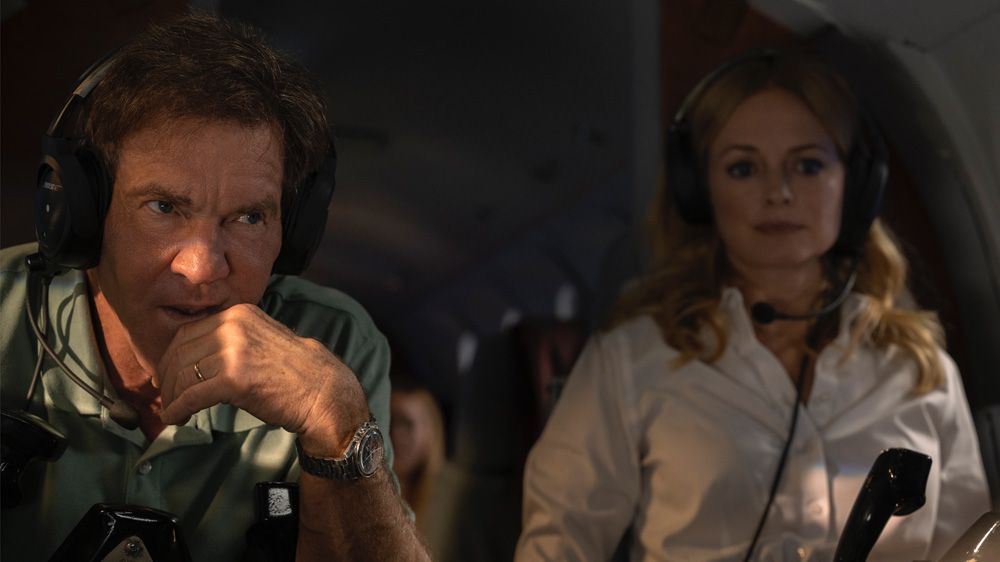
“We knew from the beginning we needed a King Air 200 plane we could modify to allow for filming on a stage, as well as a real plane to fly on camera. We also knew we had to build a large, elevated airport tower set with a huge 300° airport Translite backing outside the windows.”
“About six months before the scheduled prep date, Sean and I flew to Las Vegas where Scroggins Aviation had a King Air 200 in their workshop which they bought for us, essentially the “main character” in the film. They had already chopped off the wings, the tail and the engines so we asked to also make the cockpit and (separately) the windshield removable as well.”
“Our grand plan from the beginning was to put the plane on a gimble to really shake the actors and sell the drama of a plane out of control. When we realized that this would elevate the plane by about 8', it would be even harder to enter and exit, and harder to get cameras up to cockpit eye level, we abandoned that and ended up using special effects airbags to shake the plane. It worked well and saved a lot of time.”
“I realized then that there were literally only ten inches between the cabin seats, and that only one person could move at a time inside the plane. You couldn't stand up straight either (the cabin height was only 4'10”), and the cockpit was really hard to get into, even without a camera. It was no question that this film had to be shot with multiple cameras. The other consideration was the concern of having Dennis Quaid and Heather Graham stuck sitting in a super tight cockpit for numerous days. We knew we had to collect as many simultaneous angles as possible to lessen the pain for them.”
“In order to get the actors accustomed to the super tight space inside the plane, we first taped out the interior cabin on the office floor with six chairs and a printed copy of the pilot's instrument panel (and fake yokes) to rehearse the scenes inside the plane. Once we were on stage, we created the same taped-out space to rehearse the scenes before getting them into the plane – and started shooting immediately once they sat down.”
“Dennis likes to travel with his dog Peaches. As he arrived on stage for the first time to see the plane, Peaches was first to climb up the stairs and get inside. Of course he very quickly ended up in the pilot's seat and within minutes had 20 crew paparazzis taking pictures of him “flying” the plane.”
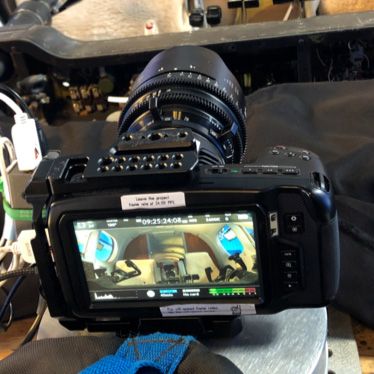
“As part of our setup we used three Blackmagic Design cameras: an URSA Mini Pro 12K and two Pocket Cinema Camera 6K Pros. My fantastic first assistant camera Ryan Pilon figured out that the Mini Libra remote head on a 30' Technocrane under slung would just fit through the cockpit (windshield out) and could travel all the way into the back of the plane to achieve the other passengers' closeups. It was very cool but difficult to manage. We also put large openings in the sides at the back of the cabin, prepped as camera ports, so we could fly the Technocrane with an Cinemoves Oculus remote head from a wide shot of the plane into the cabin and land on close-ups of our desperate heroes. Those were some of the super dynamic shots we were hoping to accomplish early on, and we did.”
“After some testing we ended up putting one of our cameras on a ceiling track that could travel from the back of the plane all the way to close up shots of the actors in the cockpit. It wasn't easy to operate in such a tight space, but it was quite dynamic and very engaging as people moved about the plane. The ceiling track couldn't be framed out with the necessary wide lenses and so was erased in post production.”
“One of the benefits of the URSA Mini Pro12K on this production was that we could use it operated or just planted somewhere in the plane and shoot at a very high resolution. We could then later push in for a secondary size of the same angle.”
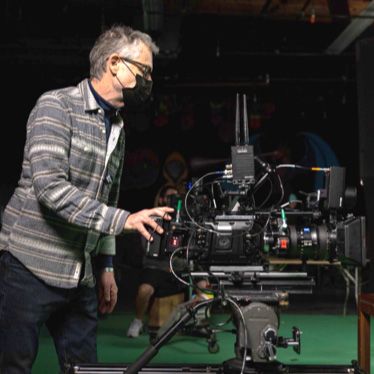
“I used the Vantage MiniHawk lenses because they have a super close focus, and are relatively small lenses. I tend to shoot mostly around T2, maybe T2.8. When doing a very personal, dramatic story I feel it's important to get the audience on board to identify with the characters, so the Depth of Field was shallow when possible to focus the audiences' attention on our heroes. With the MiniHawk close focus compact lenses we could work in that super tight King Air airplane and still get these dramatic, meaningful shots, though we had other prime and zoom lenses in our kit as well. In addition to the Vantage MiniHawks we also carried a set of Zeiss Master Primes, An ultra wide Zeiss 8mm Ultra Prime and two Angenieux Optima 1 zooms.”
“We had an additional URSA 12K action unit for two full days at one of the Georgia airports, standing in for Marco Island Airport (in Naples, FL) to shoot, for example, sequences of the airport fire department sliding down the pole, jumping in their trucks and rushing toward the landing site, anticipating a potential crash. Also placing the 12K unmanned very close to the runway gave us the flexibility to reframe depending on where our (real) King Air 200 touched down or taxied past the camera.”
“Another shot I am very proud of and after working in there for a week never thought was possible, was an URSA Mini Pro 12K on a low profile fluid head with the fantastic ARRI Ultra Prime 8R lens on the floor in the back of the cabin. As the mom and her two daughters are praying in desperation, hoping for some ‘divine intervention,' I wanted to do a 360° super low angle shot of their teary faces holding hands. With the help of my first AC Ryan, who was laying on the floor and slowly and continuously spinning the camera we got a very emotional and dramatic shot and it's in the movie.”
“Imagine a film where your main characters are pretty much immobilized inside a tin can for a large portion of the story. To make it palatable for the audience, we needed to keep the shots as dynamic as possible. Before I had even gotten involved, Sean already had ideas to fly from wide exterior shots of the plane way up in the air to the inside of the plane, landing close up with our family.”
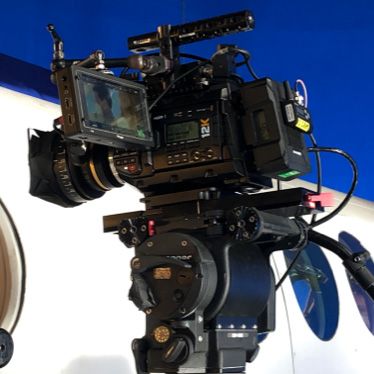
“We began to plan Technocrane moves on a track on stage, taking us from 30 feet away (with a visual effects augmented digital King Air fuselage, wings and running engines) to closeups of our heroes inside the plane. Especially with the tight spaces making it really challenging for us, we needed the film to feel dynamic and engaging.
“Due to the very compact size of the Pocket Cinema Camera 6K Pro, we built a rig that could control remote focus and remote aperture, which allowed us to go handheld in those super tight spaces, especially in the back of the narrow luggage compartment where some of the action takes place. We also could take the cockpit cover off and stick the Pocket 6Ks inside the mechanics of the yoke, close and low to the throttle and the rudder pedals. It was important for me to see Dennis' face at the same time as he is trying to master the complex controls to save his family's lives. These were definitely some of the hardest shots of the film!”
“To get super close and dramatic shots of the instrument panels telling us what the plane was actually doing, we used an Innovision Probe II Plus, a fantastic tool and one of my favorite lenses. This was mounted on the URSA Mini Pro 12K, which gave me some amazing angles. We also used the Pocket cameras all over our airport tower set to cover air traffic control characters.”
“The cameras have a fantastic dynamic capture range and sophisticated color processing. The images are indistinguishable from other high quality cameras in the final cut, and the camera's color science gives me plenty of dynamic range in color correction. With the efficiency of Blackmagic RAW, there was no need for external drives either. We recorded with in-camera C-Fast cards, which helped keep the cameras quite compact.”
“At first the many challenges in prepping a feature film like this can be mind boggling, but with the help of all our great collaborators everything always gets figured out. Solutions come from many departments and often unexpected places. That is one of the absolutely magical truths about working in this fabulous industry. If life always finds a way, so do we on any movie set. We visually tell a story we are excited about and we always hope the audience is willing to go on a ride with us and our characters and experience something they won't forget.”