James Perse - Robertson House
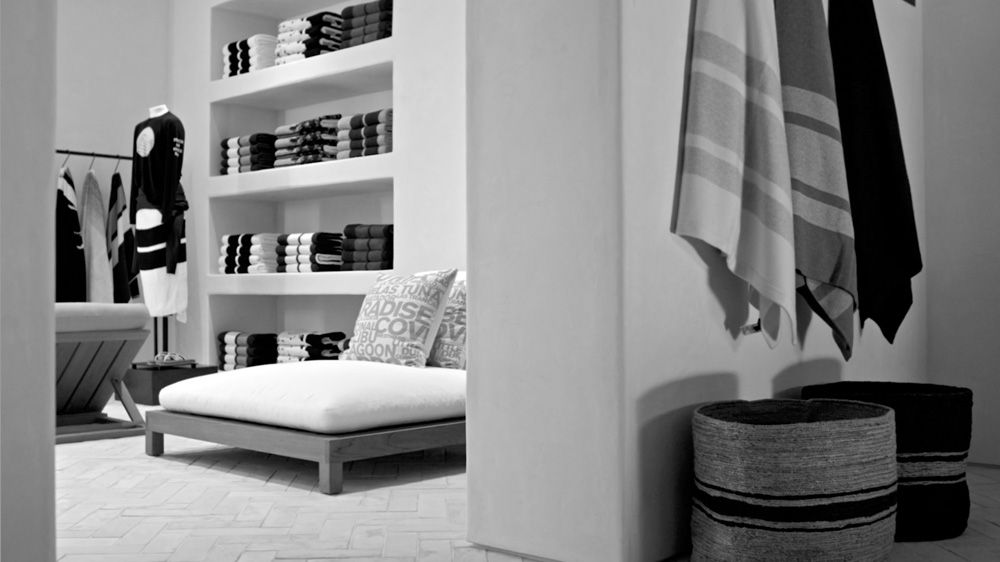
“James owns a house in Baja, which is a beautiful architectural home overlooking the sea cliffs. Not only is it stunning, but it seemingly emerges from the landscape with all of these organic earthy tones. And so, the architecture of both of these locations really informed the way this project ultimately looks.”
“Knowing the quality James was going for, I suggested to the director we shoot on Blackmagic Design’s new 12K URSA. My first experience shooting in 12K was with one of the URSA prototypes, on a road trip up to San Francisco during the forest fires. The images I was getting off that camera were simply stunning! But I wanted to see it in a more structured environment, rather than me just running around shooting pretty shots handheld.”
“I also really wanted to see what the 12K sensor could do in black and white.”
“Now it’s risky trying out a new camera on a commercial job, and more so, when you’re using prototypes! But I wanted to explore this camera in a real world setting. What’s beautiful about this sensor is that it has these incredibly fine pixels.”
“If you’d told me before using this camera, that I would want to shoot 12K, I would have told you no way! My initial reaction was that it was going to be painfully harsh. How wrong I was, with all of that detail information, I expected that hard edged over sharp digital look. To my pleasant surprise it gave a beautiful filmic look to the images.”
“I especially noticed this while shooting the fabrics in macro. The image quality has a sharpness that actually gives you this creamy-buttery look, if that makes sense! The URSA 12K is not what you would expect at all. I do think Blackmagic have created a true cinematographer’s sensor with this camera.”
“What’s interesting shooting black & white with this sensor, is if I’d shot on a camera with a CMOS sensor, I’d expect to see banding with the grey areas where the pixel values are close to each other. Now with the Blackmagic sensor, I didn’t see any banding at all. Nothing. Even in the low res cuts, there was no banding!”
‘Because the pixels are so fine, and because they are RGB and not CMOS, they were able to define themselves without the transitional banding I was expecting to see in Resolve. And that was pretty spectacular.”
“I am not a tech-hound, although I am bit of a geek. I am a shooter, so everything is about the artistry of the image. What I did find interesting, comparing the 12K URSA to the 4.6K URSA, is their marketing says it’s has one stop less dynamic range. 14 stops as apposed to 15 stops. I shoot with both cameras and in a practical sense, I didn’t notice any difference at all, in terms of dynamic range.”
“Because there were a lot of hot whites with this shoot, even when I got into clip, the 12K was still very clean in the roll-off. There wasn’t anything I couldn’t recover in the highlights, so I really feel this camera has more dynamic range than is stated.”
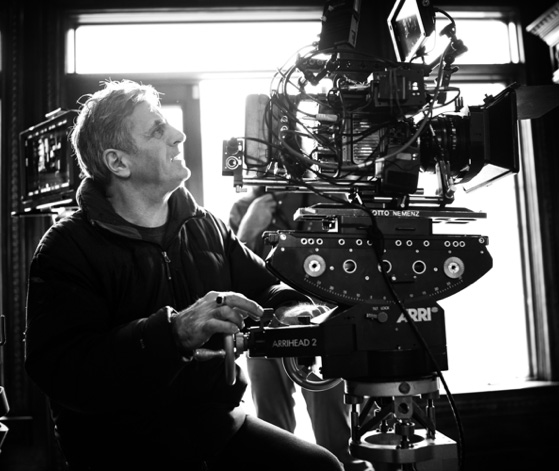
“With a job like this one, I shot all primes. I had a Fisher 10 Dolly with a Weaver Steadman fluid head and the URSA underslung on a Straight Shoot’r jib arm. So I basically operated the dolly, with a jib arm which I was walking along with while operating the shots.”
“The space was always going to be tight which is why I used a full set of Cooke S4 primes. Because of the close focal lengths with some of the shots, it was just easier for me to swap out a prime than try to reposition the dolly and crane. For example, when I was in the kitchen I was hard up against the wall, tracking that wide tracking shot.”
“With the Cooke primes my working stop for all of the interior shots was T4. Simply because we wanted to see the depth and space of the environment, so holding focus was very important at the same time still having some focal separation. When it came to the macro shots, I was shooting at T11-T16 with the T-Rex lens system; it’s a rotating periscope lens, and wide open on this thing is only T6.3!”
“Shooting a black & white spot takes extra effort with the lighting to make sure you have the perfect tonal range. With black & white, you can’t hide. There’s no cheating. So a lot of my time was spent unscrewing the in house light fixtures or taping over lights, and then working out how to bring in my lighting to enhance the space”
‘With some scenes I was putting up blacks to kill ambient light or negative fill to increase contrast. Things like double shadows and overlapping hard light will ruin your shot, so you have to kill all that stuff. So I was very specific on things, literally taping over a light fixture and then un-taping it just to get it right.”
“So this project was a combination of Litegear LED light matts, hard Fresnel lights, and a couple of ellipsoidal lights. I also created a custom B&W viewing LUT for the URSA. Having a greyscale to work off really helped me to get the right light values for the grade. Having it in color does not help seeing the tonal range which is important.”
“It literally took me five minutes to get a solid viewing LUT. While I was shooting the first scene, I dumped it into my laptop and then graded it in DaVinci Resolve. After a basic balance I added an append node to turn it to B&W and made a final contrast adjustment, so there was no leakage of color into the image. I then just exported that LUT back into the URSA which came out through the Blackmagic Video Assist. So the acid test was when we viewed that on a 17 inch professional Sony OLED monitor, where it just looked so beautiful.”
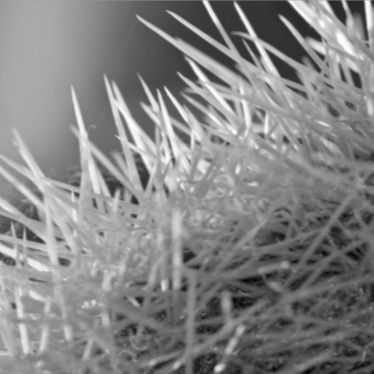
“James and Julian’s idea for the commercial was to show how all of his products are in someway grounded in nature. And so a lot of the scenes show different products rising up out of the nature around California, Malibu and desert areas near Palm Springs. One cool example of this was the macro scene where you are looking at the spines of a cactus tree and it blends into one of his fabrics. The fabrics I shot on the T-Rex and for the cactus spines, just a regular Zeiss 100mm macro. I wanted shallow depth of field, so I ND filtered it down until I could shoot at around T5.6”
“The only time I jumped off the URSA was for the time lapse sky shot and the road shot. The night sky was shot in the desert, where I sat from 5pm to 9am freezing my nuts off doing a 15 second exposure every twenty seconds on my Nikon D850. I have a special external time-lapse setup that automatically adjusts exposure from day into night. So there wasn’t much to do on this shoot other than sit there all night enjoying the 30°F weather.”
“The other scene where I jumped off the URSA, was the road shot. For this shot I went for the 4K Blackmagic Pocket Camera and 10.5mm Voigtlander still lens, which was cine modified by Duclos lenses. I mounted this set up to the front of a Chevy Suburban. I have a small triple suction cup rig that took the weight of the camera and had a monitor inside the car. This allowed us to drive off center a little, to hit the centerline of the road in the camera. The camera was getting bumped around a bit, which we easily fixed in post with image stabilization in DaVinci Resolve.”
“We were all incredibly surprised with the footage we got from the URSA 12K. Everyone from the director through to the client, James Perse, were really blown away by the image quality. The director we’ve been working with for over ten years now, so the footage needed to be outstanding for us to risk using a brand new camera, let alone a prototype.”
“James Perse didn’t really know anything about ‘Ks’ before this shoot, so for him, shooting 12K was a non factor. But he certainly knows what quality looks like. So the camera held up beautifully and didn’t miss a beat, which is all I really wanted.”