Britannia Beach and Outbound
“I’ve done a ton of commercials with Jacob before, so we know each other’s style really well. Jacob is an interesting guy who has worked with top-tier influencers and brands across the world. I think he’s been to over forty countries from memory, so he has a very unique view of the world.”
“As a teenager, Jacob was a bit of a prodigy in the social media world. Clothing brands sent him all over the place creating content for them, and so from that, he has this amazing network of contacts and friends. So the founders of Outbound Station came to Jacob asking him for help with launch content for a burger shop they had opened at Britannia Beach, which is just north of Vancouver.”
“Britannia Beach is somewhere I personally love to shoot. And it has been the location for a ton of TV series and films, like The Last of Us, Scooby-Doo and Shōgun! Because of the location, Jacob developed up this really cool storyboard with bunch of drone shots and car mounted shots for a 30sec commercial. But by the time we came to shoot, the concept had been pared-back to a 15sec spot simply due to the limited budget.”
“Because the burger shop was such a massive investment for the owners, Jacob and I created the commercial in our own time for free. It was just a fun little spot to do. And ultimately, our payment would come in burgers and coffee anyway! All of the talent in the commercial were people working at the burger station, which as you can see, was made from shipping containers. In the end, it was an incredibly quick shoot shot over a couple of hours in just one evening.”
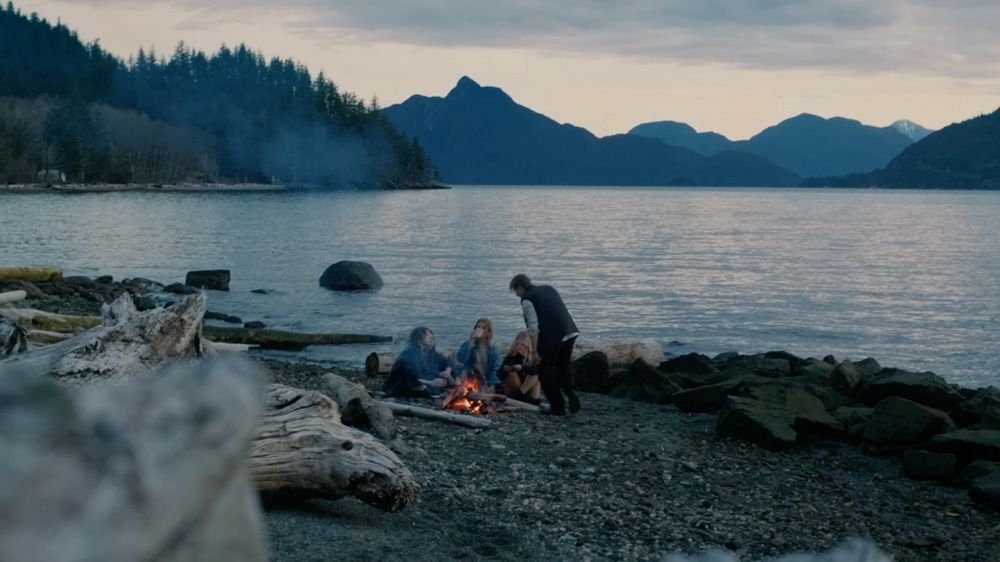
“When we arrived, we weren’t too sure what we would get in terms of light and weather. We did try a makeshift car-mount strapping a tripod to a Jeep, but that was a bit of failure. So I just went hand-held for the whole shoot because I wanted the flexibility and speed of finding the right shot around the talent. So the idea was all about friends grabbing some food and coffee and sitting around the campfire on the beach as the sun sets.”
“This was shot in April or May between six and nine in the evening. The mountains are so big up there that the sunset was completely hidden at this hour. Having the mountains backlit like this, created a wonderful after-glow that really helped with lighting these scenes.”
“The opening scene with the two girls and guy walking to the fire, was an important establishing shot to get right. Given there was only Jacob and myself on this shoot, I didn’t have luxury of lights or even a bounce to help with fill. I had to work with what was there. So I tried to position everyone where the water worked as my reflected light, and some of the driftwood trees as my bounce. It was all about finding the right seating location for each of the talent for the best shadows and highlights.”
“I was shooting at ISO 800 because I was trying to get as much highlight roll off as possible. If you look at the sky you can nothing is even close to being clipped. There was not a whole lot of contrast at this hour, so the trick is to try and maintain as much highlight as possible and as much information as I could. Although exposure is very important, it's also important to know what you want to do with your dynamic range!”
“There are a lot of cameras out there with lots of dynamic range. But still not as much as our eyes have! So no matter how much dynamic range a camera gives you, you still need to learn what happens when you push middle grey. With enough control over where your middle grey is going to sit, you can make your camera feel like it has extra stops of latitude.”
“With this shoot, having detail in the shadows wasn’t so important to me as I didn’t need all that much information with this sort of daylight. What was important was keeping detail in the sky and the skin tones. And so by raising my ISO to 800, I was able to push middle grey up a bit, for a more natural highlight roll off on the girl’s faces. From memory, I think I had around three stops of ND filtration. If I was shooting this again with a better understanding of when the light was going to fall off that night, I would have come down by a stop in ND. That’s the great thing about these sorts of shoots with no external lights, you learn very quickly how to adapt to changing light conditions.”
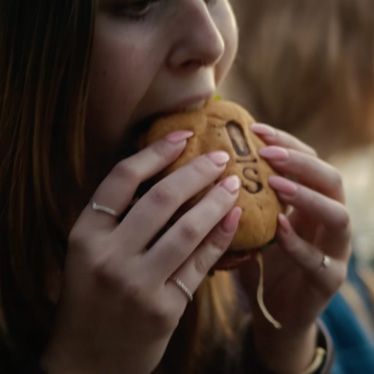
“The other thing that really made this commercial work for me are the clothes they were wearing. I had no control over the wardrobe, so you get what you get. Fortunately, the jean shirt on one of the girls really popped. The colors for all of the girl’s clothing was kind of punchy and nice even though the colors were still muted. That was certainly a bonus”
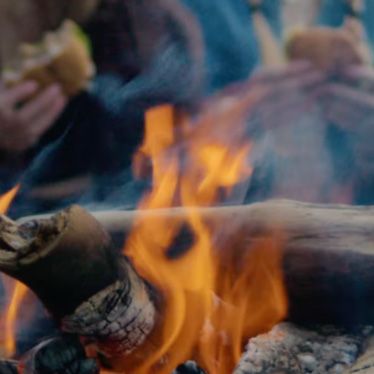
“The after-glow behind the mountains seemed to last for a long time, and then boom, the exposure dropped dramatically. So this sort of lighting can be a real test for any camera. However, the blues were just so good coming out of her jacket, and the tones were great too. There was good separation between the background blues and the foreground blues. And in the background, I had this sort of red and orange thing happening versus the glow of the fire. All that subtlety in color and tone is was what I loved most about this shoot.”
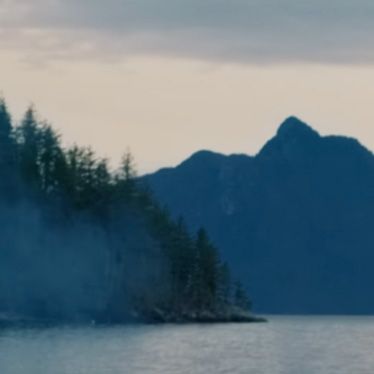
“There were a lot of happy accidents to this spot. The weather was great and it was nice to have some clouds in the sky that night. The location was great of course, and there was plenty of depth to the perspective thanks to the mountains. And there's even depth between the mountains and the shoreline. Then there are those little wisps of smoke coming out of the fire that create all this atmospheric haze.”
“Having no lights or an assistant for reflecting light meant that all of my equipment had to help as much as possible. With cinematography it’s all about making a two dimensional image feel three dimensional. And a lot of things have to work together to give you that sense of depth. Certainly, my Leica R lenses were helping with their bokeh, which is very smooth. But the color of the clothing is what really makes things pop giving this feeling of dimensionality. I think everything feels three dimensional without being overly contrasty and sharp.”
“I had just got a Blackmagic Pocket Cinema Camera 6K and this was my first commercial project using it. I also monitor using an external Small HD monitor. I know a lot of folk use this monitor for exposing with given it has L Zones, but honestly, Blackmagic’s histogram is king for exposure in my mind. Using the histogram is much faster for me.”
“I have been exposing this way for a long time and I know where things should be. The great thing about exposing with the histogram is I just flip what I am seeing in my mind to the waveform in DaVinci Resolve. As I mentioned, I work my ISOs a lot as I am always looking for the best place to land middle grey. So having experience color grading in DaVinci Resolve certainly helps in understanding how to expose my shots correctly on location.”
“In this case, I was playing with the contrast ratios. So there was no point holding a ton of information in her hair as an example. It would have made a worse image in my opinion, because I was looking for good contrast values between her hair and cheek, while still holding the soft wrap of light on her hand and burger.”
“I must have had enough footage for a 30sec spot, but 15sec seemed like the right length. People get bored quickly, so you have to keep the edit jumping along! This commercial is not a sequence of perfectly captured still photos, so imperfections in the cinematography also help to make this feel real, and more fast paced. I'm thinking of the shot where the blonde girl turns around where she wants to give a burger to her friend. This shot is front-lite and far from being perfectly exposed. It’s so quick, it’s almost out of focus. This is the sort of shot that would usually hit the cutting room floor!”
“I think these types of shots work really well at giving authenticity to the moment you are trying to show. With a commercial of this kind, the critical thing is energy in the edit. That was my vision for this edit and the color palette as well. I used the Kodak 2383 LUT in DaVinci, that I know a lot of people also love to work with.”
“All I did for this look was color space transform the footage to Cineon log and then put that particular Kodak print LUT on my last node. I was able to still achieve a look that doesn't necessarily look like it's trying to be something else, other than what it needs to be. It wasn't pushing for a crazy film look, or pushing to be anything other than feeling real. I believe I added just a little bit of grain, maybe a little bit of glow. I really like the dreamy glow effects in DaVinci and probably a little bit of color separation with her jacket too. I did tweak some of the hair color a bit, but left the skin tones alone. So just like the skin tones in this spot, the whole look was true to life, and very natural. And that’s just how I like shooting my commercials - true to life and natural!”