Blurred Lines
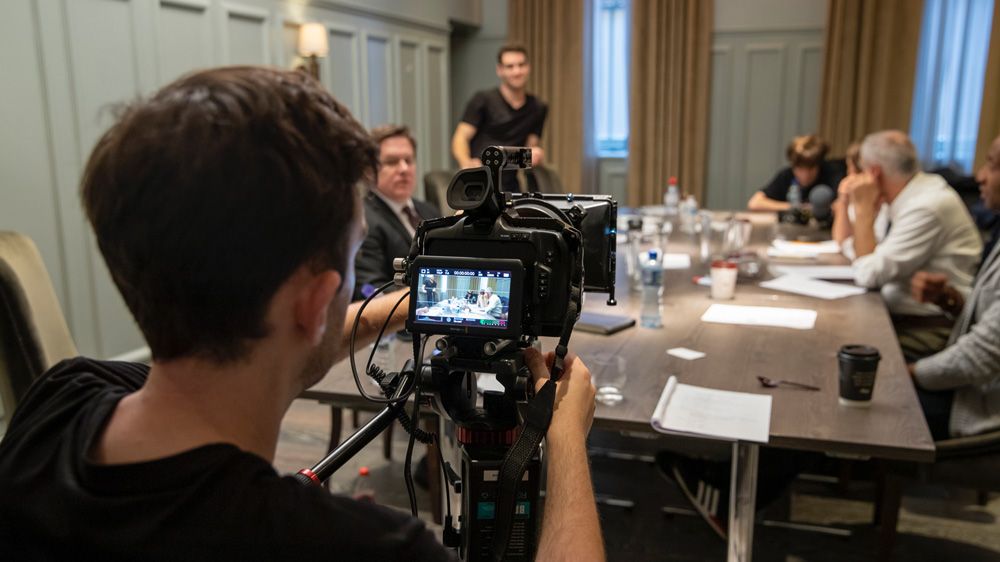
“I developed an interest in filmmaking because my Dad enjoyed filming things. He would record his students' performances and his lectures and would provide me with his camera and encouraged me to learn editing and camera operation. We actually used the first ever Blackmagic camera to shoot all of his lectures. I still love that camera.”
“When the Blurred Lines case was unfolding, I had already left home. I had worked on a documentary project for a British television channel called 'Channel Four' and was searching for new projects. I kept myself informed about current events and the Blurred Lines trial caught my eye. I casually suggested to my dad that it would make an interesting lecture for his students. As the trial grew more fascinating, the deposition tapes were eventually released and that's when I had the idea of recreating the deposition tapes with actors to tell the story of how they came about. The deposition tapes had gone viral on YouTube and they revealed a lot about the inner workings of the music industry, the nature of fame, and its corrupting influence. It seemed like the perfect fit for my next project.”
“My vision was to take a court deposition transcript and transform it into a dramatized piece. I find the blend of documentary and narrative filmmaking quite exciting. It involves using existing material like a YouTube comment section or, in this case, a deposition transcript and incorporating as much of it as possible as actual lines of dialogue. When I saw 'The Social Network,' it was truly revolutionary. They had a whole sequence where they took Mark Zuckerberg's blog and had an actor deliver it verbatim, cutting to him as he described building Facebook in his blog. They took that transcript and turned it into an amazing film sequence. I felt there was something similar that could be explored, and that's what I wanted to do.”
“I have worked on some documentaries, but the reason I got into filmmaking was because I wanted to collaborate with actors and work on scripted films. To bridge the gap, I approached it from my documentary experience, treating it as documentary research. I took key excerpts from interviews and adapted them into scripted scenes. The early drafts were terrible because they consisted of what was said and who said it. When people recount what was said, the dialogue often becomes dry.”
“Eventually, the project started taking shape when I had actors perform the scenes. It dawned on me that I needed to exercise creative license in rewriting the material, but to keep the essence of what was said. As a filmmaker and primarily a director, I have a clear vision of the overarching story. However, the script is always like a jigsaw puzzle, attempting to make everything fit. I know that once I begin shooting, I can further experiment with it. The starting point was taking the deposition transcripts, incorporating real-life interviews, and adapting them into scenes, which were then arranged to form a cohesive narrative.”
“It took me six months to conduct the research, but it wasn't a continuous process every single day for six months. It was spread out over that period of time. I vividly remember constantly discovering new sources, delving into more information and meticulously constructing a timeline of events, attributing statements to individuals and identifying the corresponding sources. Once I had gathered all this information, I had the complete story.”
“During that time, my brother was studying music at university and he sought my advice for his dissertation topic. I suggested he explore the sources I had gathered on the Blurred Lines case and write an essay examining whether the song was plagiarized or not. He took up the challenge, and his dissertation yielded some intriguing things that I hadn't come across. Using his work, I incorporated elements from his dissertation, making the project even better. The extended period due to the pandemic truly enhanced the final product. Once the pandemic was pretty much over, I enthusiastically dove into rewriting the script from scratch and brought the project to life.”
“The entire project was self-funded. I actively pursued film funds and had several meetings with poeple who had previously provided me with film funding. One of them flat out declared it impossible, and they all expressed doubts, primarily due to the casting process. They believed that the success of the entire film hinged on securing Pharrell Williams and Robin Thicke for the roles. However, what they didn't realize was that the casting process was crucial for every single character, as they were all based on real people.”
“Nonetheless, the primary focus was on getting Robin Thicke and Pharrell Williams right. They insisted it couldn't be done and questioned whether I could find American actors residing in London or British actors capable of delivering convincing American accents. I held a different perspective. I saw it as an opportunity. If I could find these actors, the production value would skyrocket, leading people to assume I had a substantial budget, simply because I had secured the right talent. In reality, it was just a matter of investing ample time in thorough research, scouring websites, Instagram, and other platforms until I discovered the right talent.”
“It turned out to be a blessing when those individuals expressed doubt, because it granted me the freedom to pursue the project on my own terms without their influence. I had complete creative control and could experiment and even fail if necessary. What makes it great for me is that the project has been met with success, receiving awards and being showcased at prominent film festivals. The feedback I've received has been exceptional because the final product truly reflects my vision. If I had embarked on this project three years ago with the individuals I was initially pitching to, the outcome would have likely been different and probably less well-received.”
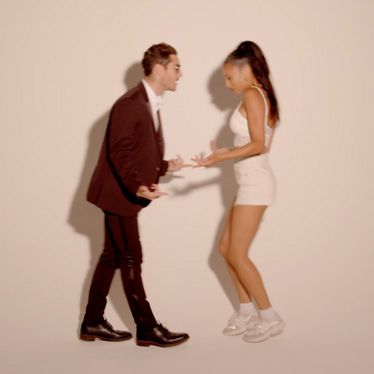
“When I was contemplating how to approach the recreation of the music video, someone questioned, "How are you going to do that? Recreate the music video in real life?" The truth is, the original music video had been made on a shoestring budget as the record label didn't want to invest much in it. The decision to have topless women in the video was a deliberate attempt to generate buzz and captivate viewers, considering the song's unconventional nature for a pop track. They were looking for a bold marketing strategy to compensate for the low budget and the song's unique style, aiming to get discussions going and draw attention.”
“Fortunately, this presented an advantage for me during the filmmaking process. I could easily find a studio with a plain white wall, as that was the primary backdrop of the music video. Additionally, I had the freedom to exercise creativity in designing the deposition room since, in reality, it simply took place in an ordinary office setting. The office location I ended up choosing was a beautifully designed meeting room underneath a hotel in London. It wasn't excessively expensive since it wasn't originally intended as a film set but, rather a functional meeting space.”
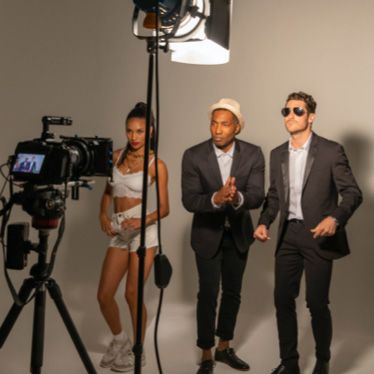
“I consider myself lucky when it came to securing the final location. I reached out to an agency that represents recording studios because I needed a studio for half a day. However, their response was not good as they didn't typically rent out studios for a half day. Given my budget constraints, I came up with a solution. I asked if they had a client who only required half a day and if I could have the other half. To my surprise, they agreed. I didn't have the opportunity to see any pictures or know what the studio would look like, so I was really hoping it would meet my needs. What I specifically envisioned was red walls for the setting, and low and behold, that's precisely what I found! The color scheme of the film and the music video perfectly matched. It was like I had a production designer on board but really it was just a bit of good fortune.”
“During my college course in filmmaking, the college had the privilege of hosting various directors who would share their insights with us. I often asked them for advice, but I found myself always disappointed by their responses. Their advice consistently revolved around the importance of casting talented individuals. They would emphasize that their role as directors was primarily about assembling the right team and then overseeing their work. Initially, I didn't consider this to be a particularly great answer, as it seemed like they were suggesting their job required minimal effort. However, as I've gained more experience in the field, I've come to realize that their advice is indeed true. Casting the right people, who possess the necessary skills and chemistry, can greatly influence the success of a project. The director's role then becomes one of guiding and overseeing the talented individuals they have assembled, ensuring they can deliver their best performances. So, while it may have seemed like a simplistic answer at first, I now understand and appreciate the wisdom behind it.”
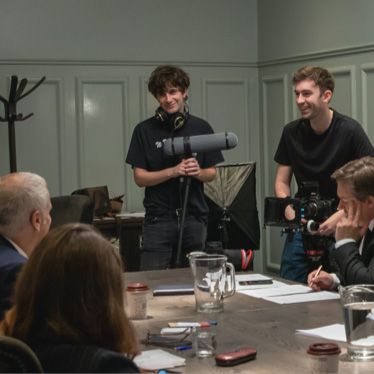
“Due to budget constraints, I had allocated only two days for the entire filming process. I wanted to respect the actors' time and avoid getting entangled in a project that would drag on and on. Day one was dedicated to capturing the scenes in the recording studio and shooting the music video. We began with the recording studio scenes in the morning and transitioned to the music video shoot in the afternoon. On day two, we focused on filming all the deposition scenes. The deposition scenes were particularly interesting because they involved a lively room. The room accommodated five actors, myself, my assistant, and a behind-the-scenes crew member.”
“We had already conducted a read-through prior to the actual filming, but due to the pandemic, everything was done remotely over Zoom. Because of that, I never had the chance to meet the actors in person. On the day of the shoot, it was just myself, my assistant, and the actors portraying Pharrell and Robin Thicke. As we commenced with the first shot, I immediately sensed that everything was going to be fantastic because the actors were absolutely phenomenal. Their chemistry was there right from the start, and they connected effortlessly.”
“Once we completed the initial scene, which turned out to be amazing, I felt at ease that the rest of the filming process would be smooth sailing. These actors were just so confident, passionate, and had a genuine desire to deliver outstanding performances, which just made me so confident in the project.”
“One of the actors happened to be a comedian and a close friend. I anticipated a lively and potentially unruly energy that I would need to manage on set. However, to my surprise, everything went incredibly smoothly. Each actor was enthusiastic about their involvement and displayed a high level of focus. We started our day at eight in the morning and wrapped up by six in the evening, which is just a normal filming day. It was a testament to the professionalism and dedication of the cast and crew.”
“A valuable lesson I learned from this experience was the importance of understanding the time required for various aspects of the production. I had to make some difficult decisions and cut certain scenes because I knew that squeezing them in would lead to exceeding our allotted time, which could upset the actors. To make everything transparent and to avoid any misunderstandings, I made sure to provide realistic time estimates on the call sheet. This way, everyone was aware of when they could expect to finish their work. There's nothing worse than running behind schedule, so careful time management became a key priority for me.”
“I took on the editing process myself using Adobe Premiere Pro. The footage was captured using the Blackmagic Pocket Cinema Camera 6K. Throughout the production, I shot the entire project in 6K resolution, using the Blackmagic RAW format at a compression ratio of 5:1. I didn't require a proxy workflow and instead edited the raw files directly. For the grading and final output, I performed a round trip to DaVinci Resolve, the whole process was very easy and enjoyable.”
“In terms of lenses, I relied on two main options. The first was the Sigma 18-35mm lens, which really works well with the Blackmagic camera. Its performance and characteristics were a great match for my needs. I also used a Zeiss 50mm prime lens to capture specific shots. I was really pleased with the results achieved, as I had become familiar with the sweet spot of both lenses, enabling me to capture exactly the look I was after.”
“One of the lessons I learned from this project was related to sound. Despite owning my own sound kit, I made the decision to hire an expensive sound kit, recognizing the crucial role sound plays in any film. Unfortunately, it turned out to be a major mistake. It was simply bad luck that the kit, despite its high price and specifications, must have been old, resulting in various sound issues. There was spectral noise throughout the recordings. After completing the initial editing and grading within the first three or four months, I found myself constantly seeking new sound professionals in an attempt to rectify the sound problems.”
“I eventually approached a sound engineer and explained my predicament to him. He recommended a few plugins for me to purchase and instructed me on how to improve my sound recording skills. Consequently, I now possess better sound recordings and I am capable of handling sound mixing on my own. The experience taught me an important lesson: although I initially chose to overlook the intricacies of sound, I eventually had no choice but to delve into it. It was truly disappointing that I had not explored this aspect earlier.”
“I have just completed a follow up in terms of themes to Blurred Lines. It’s again exploring someone in the music industry. The trailer will be out soon!”