Carey Dissmore
“Looking back, I am not too sure how I even got into this. I did have a fundamental love of computers and production when I was 10 years old, so I guess that's where it began. I do remember grabbing my father’s film camera and never giving it back to him.”
“When my elder sister bought a Super 8 camera, I then figured out using a circuit diagram that I could make a light blink like a strobe on my home electronics kit. So I connected this thing up to a 1.5 volt battery and a mini plug, which I plugged into the camera and figured that it caused the camera to shoot one frame per tap on a switch. So here I am at 12, using my home electronics kit to do stop motion on my sister's film camera. I was always messing around with that thing, doing stop-motion and claymation sort of things. I never consider for a moment that I would end up making a career out of it though!”
“However, it wasn’t until I quit my first college that I fell into production, thanks to some skills that I had acquired doing our local high school TV and radio shows. I started off studying computer sciences at a new college, but all I was doing was working on billing systems and databases, whereas what I really wanted to make were computer games. So there wasn’t a clear cut career path that I could see for me at college.”
“A friend of mine then let me know about a new cable company that had set up in town, that had a community access channel as part of the plan. There was also a professionally staffed local channel. I impressed them and was hired, first part time, then it soon became a full time job. We were doing all kinds of things from minor league baseball, college football, hockey, basketball and city council meetings. You name it we did it.”
“We had an OB truck with a 6-7 person crew, 3 cameras, a Grass Valley 100 live switcher and U-matic decks. We also had two studios fully equipped with lighting grids and cycs, so it had everything you could want from a first job in broadcast.”
“The one part of the job I really loved, was working Sunday nights. At 9pm we aired a live call-in sports show, I would get the master control playback while we were on the air. I also manually queued and ran all the spot breaks for the hour that show was on. It was such a cool thing to do at that age.”
“It was a poorly paid job, but I got to do just about every job in television over the five years that I worked there. This was a flagship operation for that particular cable company, so we were beautifully equipped with the very latest gear, which was fantastic to be learning on.”
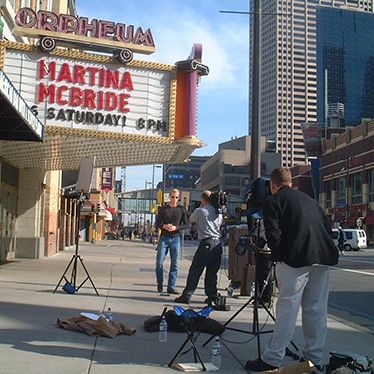
“After 5 years learning the ropes, I really needed to leap frog my career. So I grabbed the reins, relocated to Minneapolis, and went for it doing freelance camera, sound and lighting gigs all over the place. For seven years, I spent about 150 days per year on the road crewing on shows such as 20/20, Prime Time Live, 48 Hours, Dateline, as well as ENG crewing for Good Morning America, Today Show and The Early Show, just to name a few.”
“What you soon learn crewing for a lot of these magazine type shows, is how to produce a quality product on a seriously tight turn around. At the same time as doing production, I had also fallen into a post house in Minneapolis as their editor. For those who know Minneapolis, the post house was in the warehouse district. A loft space in a 1913 Model T Ford factory; so it was a really cool space. When we started off, we had a linear editing suite, a Grass Valley 200 switcher, Dubner 20k, an Abekas A53D, Betacam SP and Sony 1" decks.”
“At that time, I was really getting into After Effects and motion design, so I was pushing the guys to upgrade the equipment so we could take advantage of the higher quality. Well, the result of that, was that I scared the guys into thinking that everyday that they held on to their current equipment, that it was devaluing at an incredible rate; which pushed them to sell off almost everything! In the end, we sold off all of the core video gear and went all NLE. We bought a Media 100, RAIDs and render stations with the proceeds. We still needed more gear, so I started to buy the equipment we didn’t have, myself.”
“Back then there was so much rendering, that I could never go home. The renders crashed all of the time and they seemed to take forever. Every time we wanted to do credits, it always seemed to happen on a Friday night, and so I would spend the next 5hrs of my weekend baby-sitting the render. So I wanted to do some of this stuff from home.”
“A few years later, I found a house with a floor plan that would fit an edit suite in at the front. Buying that house was to change everything for me, because now I could buy another edit suite.”
“Once I bought my own decks and monitors and had a complete edit system at home, I found that certain clients only wanted to work with me there. So I worked like this out of two edit suites for about 2 years. This allowed me to bootstrap gear for my own suite. In the end, the quality of my gear was better than most of the established post houses around town. Then in 2002, I left the studio and worked entirely freelance for myself.”
“I came into the industry, first up, because of my interest in technology and production. It’s funny how editors have fast become the technological glue that holds the modern production universe together. We have been sitting at the front of the technology wave for awhile now, and have become the go-to-guys for any workflow related question.”
“I field calls from cinematographers all of the time about format issues, codec issues and workflow issues. It has fallen to the editors to know how to make all of this stuff work. Nowadays editors have to have all of the answers and be able to fix anything. That has been the biggest challenge in this industry, being able to keep up with the technical side of things.”
“About 1995, I started to participate on a whole bunch of web forums and lists, like the Shockwave List. I was a sponge and was absorbing everything on these lists which I then used to leverage my own work. These communities really helped launch a whole new phase in my career.”
“I wasn’t even running the forum to begin with, but then it came time for me to step up and help secure the future of this particular community. And that’s pretty much how the IMUG came to be.”
“The IMUG has really taken on a life of its own and has become what the community wanted it to be in the end. A lot of us work from home, or out of a department with only a couple of people in it, so one can feel pretty isolated at times. That’s why the online component and then coming together once a year to have a party at NAB works so well. It is just such a privilege to be involved.”